This is a free event at the NEAT Center at Oak Hill and will be held May 18, 2011 10:00 am – 12:00 pm.
This FREE presentation will give basic information about the field of music therapy and delve into the specific ways that music therapy services can benefit those with a wide variety of special needs in school, home and community based settings. Areas of focus will include: music therapy as both related service and educational enrichment within the school setting, examples of goals and musical interventions within a music therapy session, music therapy in collaboration with other related services including SLP, OT and PT, and the use of adaptive technology within the music therapy setting.
Presented by Jennifer Sokira MMT, MT-BC, LCAT and Emily Pellegrino MT-BC
Register online or by calling Julie Hein at 860-243-2869.
Monday, April 25, 2011
Friday, April 15, 2011
This is what a happy grant giver looks like
 See this? This guy here? And the smile on his face? He's a grant giver. a grant monitor. And he really likes it when he doesn't have to chase down grantees for their paperwork.
So this is his face when he gets a report ON TIME. And it contains USEFUL information that makes his life and job easier. This grantee gets a gold star: its a little early.
Thing is, for some reason he figures that grantees should be on the lookout for submitting reports, filing papers, giving information, and communicating. Being responsible. It stands to reason, doesn't it? After all, the applicants accepted the money from his program, didn't they? They signed on the dotted line, right? As in, a legal contract? And why would they risk their grants, their projects, their funding, reputation over something silly like a report that takes an hour or two to generate? He wonders, why would they want to go out of compliance with federal funding? Why? WHY?
He asks you. Most of you.
Schools/Teachers/LMS: Thomson Gale TEAMS Award
The Thomson Gale TEAMS Award is open to all K-12 public and private school teachers in the United States who have collaborated with media specialists to promote learning and increase student achievement.
Three winners will receive $2,500 and some other stuff from Gale.
Deadline: 6/15/2011
Wednesday, April 13, 2011
Follett Challenge for School Libraries
The Follett Challenge invites the education community to promote the role that school libraries play in encouraging and developing information literacy and student engagement. Demonstrate how your program makes use of technology and content to engage students and improve information literacy.
Six winning libraries will be rewarded with the cash-equivalent of products and services from Follett. Five prizes, including a $35,000 first place prize, will be awarded by a panel of judges. A sixth $10,000 prize will be awarded based on online voting for the best video.
The application consists of a detailed program description, a written endorsement of support from the school's administration and a 3-5 minute video as a creative representation of the program's impact.
More information.
Deadline: June 1, 2011
Tuesday, April 12, 2011
Scholarship to 2011 Grace Hopper Celebration of Women in Computing
This scholarship pays for registration fees, lodging for four nights, and travel expenses to the conference in Portland, Oregon in November 2011.
The Grace Hopper Celebration of Women in Computing is a series of conferences designed to bring the research and career interests of women in computing to the forefront. Presenters are leaders in their respective fields, representing industrial, academic and government communities. Leading researchers present their current work, while special sessions focus on the role of women in today’s technology fields, including computer science, information technology, research and engineering.
The majority of scholarships are awarded to undergraduate and graduate students, however, junior faculty, members of non-governmental organizations, and non-profits are eligible to apply.
The Grace Hopper Celebration of Women in Computing is a series of conferences designed to bring the research and career interests of women in computing to the forefront. Presenters are leaders in their respective fields, representing industrial, academic and government communities. Leading researchers present their current work, while special sessions focus on the role of women in today’s technology fields, including computer science, information technology, research and engineering.
The majority of scholarships are awarded to undergraduate and graduate students, however, junior faculty, members of non-governmental organizations, and non-profits are eligible to apply.

Monday, April 11, 2011

The National Historical Publications and Records Commission (NHPRC) seeks proposals that use cost-effective methods to digitize nationally significant historical record collections and make the digital versions freely available online.
A grant normally is for 1 to 3 years and up to $150,000; the NHPRC expects to award 5 grants in this category.
Here is a link right to the grant announcement, or you can keep reading:
Projects must make use of existing holdings of historical repositories and consist of entire collections or series. The materials should already be available to the public at the archives and described so that projects can re-use existing information to serve as metadata for the digitized collection.
To make these projects as widely useful as possible for archives, historical repositories, and researchers, the applications must demonstrate:
1. The national significance of the collections or records series to be digitized;
2. An effective work flow that repurposes existing descriptive material, rather than creating new metadata about the records;
3. Reasonable costs and standards for the project as well as sustainable preservation plans for the resulting digital records;
4. Well-designed plans that evaluate the use of the digitized materials and the effectiveness of the methods employed in digitizing and displaying the materials.
Projects may not use grant funds to:
* create descriptive metadata
* create edited transcriptions of the digitized materials
* develop websites where people will have to pay a fee to view the images.
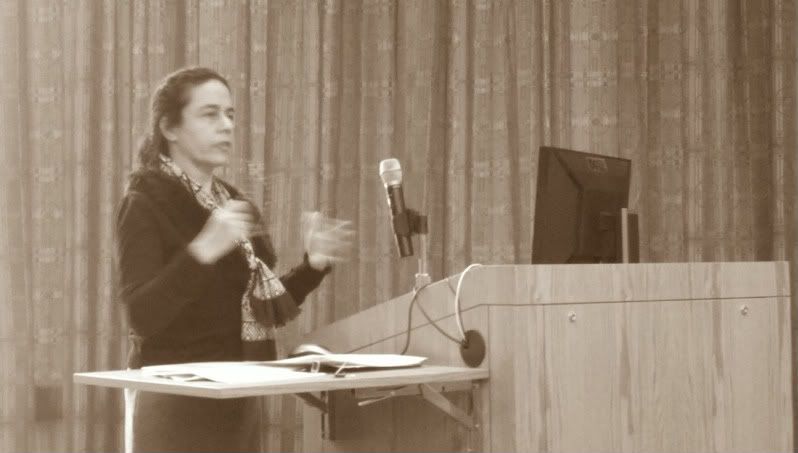
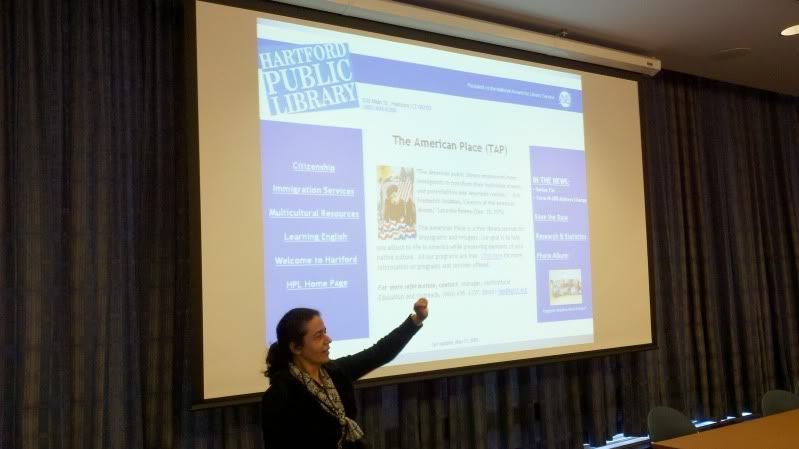
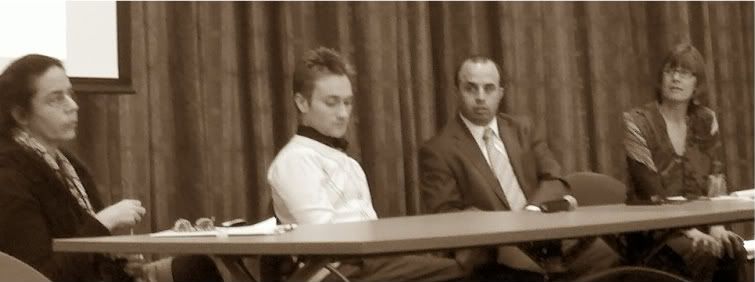
Hartford Librarian Homa Naficy Lectures Scores of International Social Workers
OK, first some definitions:
‘Lecture’ = Speaks about the Hartford Public Library’s The American Place (TAP) initiative.
'International social workers' = The students and faculty of the Center for International Social Work Studies at the University of Connecticut’s School of Social Work.
‘Scores’ = 1.5 score (since it is more than 1, it still counts as a plural!).
This informative and cheerful gathering celebrated and venerated various world cultures and also taught attendees about ongoing issues.
Naficy’s talk focused on the composition and needs of Hartford’s immigrant community and what the library and its partners are doing for them. Panelist Tom Felke spoke about the problems of ethnic Armenian refugees from Nagorno-Karabakh and Azerbaijan, while panelist David Sant talked about his experiences helping an Idaho Peace Camp that benefited refugee children by increasing their knowledge about religious diversity and conflict resolution.
Subscribe to:
Posts (Atom)